Wednesday, 10 July 2013
Kawaguchiko to Mount Fuji
I arrived at Mount Fuji's "Fifth Station", the starting point for the trek to the 3776m summit for most Japanese and foreign tourists, on a bit of a whim. I took the bus from the smallish town of Kawaguchiko, from where I had planned to run around the lake and enjoy the view of the distant volcano. Having briefly spoken to an Australian backpacker who had just returned from the mountain, however, I was encouraged to go for the climb, despite my lack of suitable equipment.
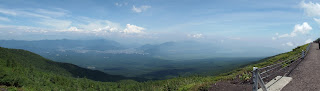
The opening section of the trek is flat, and Lake Kawaguchi is visible as part of the impressive view into the valley. After this, the track starts making progress upwards, alternating between gravelly zigzags - hard work without proper hiking boots - and steeper rocky sections which can be climbed or stepped upon. These I chose to scamper up, enjoying the physical challenge.
As the track reached the final stage before the summit, the zigzags became shorter and a chilly wind pushed clouds up the volcanic rock of the mountain side. My running shoes and thin jumper performed the necessary function and I made it to the summit. Here, I looked down into the crater, ate some of the supplies I had brought along from 7-eleven, and took a photo or two.
The descent is on a separate track - a monotonous gravelly zigzag which can be run or skipped (seriously) along in places. The gravel changes colour from black to red and finally brown, before levelling out into a comfortable stroll back to the fifth station.

 |
| 7-eleven, road workers, Mount Fuji |


 |
| Summit |
 |
| Kawaguchiko |

Branch of the sky
The broad main roads and back streets alike in Asakusa are quiet on a Monday evening. Light rain drifts down as I make my way towards the Tokyo Sky Tree, a 634m-high giant of a TV tower, the construction of which was completed last year.
I got out of the rain and into the tower complex, the bottom floors of which consist of expensive shops and restaurants. A baby looked at me in surprise and then began to laugh as I made my way to the entrance to the elevator towards the viewing floor. I paid my money and entered the lift to the 350m- high viewing floor, the lower of the two large rings around the tower. The elevator shot upwards, a space-age display showing the floor count and altitude rapidly increasing.
As I exited the lift, it was difficult not to feel emotional at the sight of the lit-up expanse of nighttime Tokyo stretching away below. It is, after all, incredible to see the size of the things humanity can build, and to consider the impossible number of lives, stories and histories all captured within one panoramic view.
People could be seen walking with umbrellas in the streets below. Advertising screens shone brightly, big enough to be read from half a kilometre away in the air. The Tokyo Dome and Shibuya Skyscrapers could be discerned in the distance. Lights blinked far away.

I got out of the rain and into the tower complex, the bottom floors of which consist of expensive shops and restaurants. A baby looked at me in surprise and then began to laugh as I made my way to the entrance to the elevator towards the viewing floor. I paid my money and entered the lift to the 350m- high viewing floor, the lower of the two large rings around the tower. The elevator shot upwards, a space-age display showing the floor count and altitude rapidly increasing.
As I exited the lift, it was difficult not to feel emotional at the sight of the lit-up expanse of nighttime Tokyo stretching away below. It is, after all, incredible to see the size of the things humanity can build, and to consider the impossible number of lives, stories and histories all captured within one panoramic view.
People could be seen walking with umbrellas in the streets below. Advertising screens shone brightly, big enough to be read from half a kilometre away in the air. The Tokyo Dome and Shibuya Skyscrapers could be discerned in the distance. Lights blinked far away.

Yomiuri Giants vs. Yokohama DeNA Baystars
A couple of stops along from Akihabara on the JR Sobu Line is the
Tokyo Dome, an impressive baseball stadium with a capacity of 55,000, built in 1988,
and home to the Yomiuri Giants, one of Tokyo’s two major baseball teams.
I arrived shortly before play was due to start. Making directly for one of the many fast food outlets inside the stadium, I bought a chilli dog
with enough of a kick to it to take the edge off the atrocious hangover I was
nursing. I had a standing ticket, which meant that I was in the gangway between
the actual seats and the fast food sellers. Due to the slight height advantage
for a European, even one of average size, I could see well by peering over the
head of those in front, including a young girl who had the words “I love you
more than anyone else in the world” tattooed on to the back of her left calf.
I have been to see a professional baseball game once before, on a
breezy evening in San Francisco nine years ago. That the Yomiuri Giants share a
name with their Californian counterparts is more than just a happy coincidence
– they used the Giants (then based in New York) as an inspiration when formed in
the 1930s. Nonetheless, there were plenty of differences to be observed, even
for the most seldom of matchgoers – there was less music, but more on-field
entertainment between innings. The two stadia are of course very different,
with the view of San Francisco Bay exchanged for a fully air-conditioned indoor
stadium which held the noise in and created a lively atmosphere even though the
home fans were sat down quietly for the majority of the afternoon.
The home team, who are the current league champions, won a
low-scoring match 2-0, with both home runs coming in the fourth innings. I just
about have a grasp of the rules of baseball – sufficient to avoid boredom, but
not enough to start complaining about the quality of the play.
A powerful breeze created by the air conditioning helped the fans
on their way as they moved en masse in a relaxed, orderly fashion towards the
exit, and I followed, doing my best to keep out of the afternoon downpour.
It wasn’t the end of the day’s sporting entertainment. I watched Andy Murray begin a fresh chapter in British sporting history with the one other British sports fan at the hostel, a young man from Leeds. As the crowd in SW19 went mad, we shared a high five and a shout of joy, while the three Chinese tourists sharing the sofa with us left us to it.
It wasn’t the end of the day’s sporting entertainment. I watched Andy Murray begin a fresh chapter in British sporting history with the one other British sports fan at the hostel, a young man from Leeds. As the crowd in SW19 went mad, we shared a high five and a shout of joy, while the three Chinese tourists sharing the sofa with us left us to it.


Geek City
I walked in the shadow of the elevated Japanese Rail track from
Asakusabashi to Akihabara – known in shortened form as Akiba, or alternately
Electric Town or Geek City. At a noodle bar on a street corner, I bought a
ticket from a vending machine outside, turned it in at the counter, and then
sat eating my fill while the two cooks went about their work in the narrow,
steamy kitchen on the other side of the bar.
In Akihabara itself, there are two main shopping streets. Both are
full of shops selling animé and manga merchandise, and there are large video
screens across many of the facades. Girls dressed in maid uniforms and various
other costumes hand out flyers. Noise from shop salespeople talking through
loudspeakers forms a background din. Both streets have a building almost
completely covered from top to bottom floor in a plain red advertising hoarding
with the Sega logo in the middle.
Like in many other of the districts I have visited, almost everyone
is young. I wandered into a couple of shops and was lost amongst the rows of
action figures, animé t-shirts and collectible dragons and monsters.

Thursday, 4 July 2013
Two days in Tokyo
 |
| Shinjuku |
 |
| Strict |
 |
| Metro manners 1 |
 |
| Metro manners 2 |
 |
| Sweaty refreshment |
 |
| Ueno Park |
 |
| Ueno Market |
 |
| Pedaloes, Ueno Park |
Monday, 1 July 2013
Small in Japan
Japan is a country I know almost nothing about. I've read a stack of Murakami books and seen a couple of Studio Ghibli films. I recently watched a Michael Palin documentary recorded there in 1997. That's about it.
The end of several months of hard work culminating in a second bachelor's degree and some saved up travel money has left me able to grab with both hands the chance of taking a holiday. I will be spending the summer in Japan and Korea.
As a student of Arab and Islamic culture, society, history and language, I'm specialised in entirely the wrong kind of orientalism for the coming 2-month trip. However, I'll record my observations and post a few photos here just the same.
Over the last couple of weeks, as I have looked forward to setting off, two songs have embedded themselves in my consciousness.
These songs, while both having Japan in the title, have ostensibly nothing to do with the country itself. This seems quite appropriate given my almost total lack of background knowledge and preparation.
A quick Google search reveals that Tokyo is 5,614 miles from Beirut. You can get lost a few times in a distance like that.
Departure first thing tomorrow.
The end of several months of hard work culminating in a second bachelor's degree and some saved up travel money has left me able to grab with both hands the chance of taking a holiday. I will be spending the summer in Japan and Korea.
As a student of Arab and Islamic culture, society, history and language, I'm specialised in entirely the wrong kind of orientalism for the coming 2-month trip. However, I'll record my observations and post a few photos here just the same.
Over the last couple of weeks, as I have looked forward to setting off, two songs have embedded themselves in my consciousness.
A quick Google search reveals that Tokyo is 5,614 miles from Beirut. You can get lost a few times in a distance like that.
Departure first thing tomorrow.
Subscribe to:
Posts (Atom)